South Africa Journals

Updated: Sep 15
I recently rediscovered these journal entries from my travels through South Africa in September 2004. I had just finished two years of Peace Corps service in Gabon.

Before I left the continent for the US, I took some time to explore South Africa. The country had developed a wonderful bus system that takes travelers from hostel to hostel.
In 2004, Thabo Mbeki was president. It had been ten years since the country's first democratic election, in which Nelson Mandela was elected.
Citizens of what Archbishop Desmond Tutu had dubbed the "Rainbow Nation" seemed to me to be in a relatively hopeful, uplifting spirit during my travels.
People I met seemed generally optimistic about social and political healing taking place in the country, despite the incredible trauma and on-going suffering nearly every one of them personally experienced.
With hindsight now, we can see that this optimism was not to last. But I feel really fortunate to have visited when I did. It was a remarkable experience for me.
Johannesburg – September 6, 2004

I had a delicious breakfast at my hostel — two fried eggs, bacon, toast — and met a very interesting man named Robin. He has spent 20 years traveling.
We talked about the importance of Arabic, about the idea of the world being too small for nationalism, his concept of progressive socialism; we talked about South Africa. He was a conscientious objector, refused to join the SA army and was put in prison.
He accompanied me to the Apartheid Museum — taking me first to see the statue of Gandhi in Gandhi Square. There were two very sweet old men sitting there who asked us who this statue was.
I thought they were joking! But we explained about Gandhi and I told them that this man, at whose feet they were sitting, was probably one of the most important men who ever lived; a significant figure in South African history, and someone who is remembered for committing his life to the pursuit of justice.
The men seemed interested.
Johannesburg - September 6, 2004
Our taxi driver was named Justice. He dropped us at the Apartheid Museum and we spent all afternoon there and didn’t nearly have enough time to take it all in.

There was an exhibit of large paintings done by victims of police brutality under apartheid. It was incredibly powerful. They had done “body mapping” — tracing their body on large pieces of paper, indicating their gunshot or stabbing wounds, documenting their feelings, hopes, desires, troubles.
I was left with a profound sense of guilt and shame — why? It’s not right that others have suffered SO MUCH just to express their basic human rights. I can’t understand, justify the grace that I have received; the freedom from this kind of suffering.
Standing there, I realized that we need to be able to internalize the suffering of others.
And this exhibit was a really powerful way to do this.
I spoke for a while with one of the people who created the paintings— Cleo. He had been a 14-year old student who was beaten by the police and put in jail. He was a member of a group of active resisters. He shot himself accidentally in the leg with a homemade gun (many of these are in the museum) when he was running from Police. His brother was shot in front of him.
Now he’s unemployed, he’s had problems with drugs, he said he used to take sleeping pills to deal with the stress and sadness. And now he wants to continue his education, but doesn’t know how.
The videos of the riots and violent mobs and struggles with police were very moving. Dead bodies of people who had been shot. Stories of houses being burned, people beaten, having acid poured on them… I needed a lot more time to internalize it. I wish I could go back, but today I am off to Swaziland.
Swaziland – September 7, 2004
I am trying to feel familiar, comfortable here. But I don’t. I can be nothing but a tourist who knows nothing about local custom.
Having just come from Gabon, I find myself wanting to speak in French to the Swazis, but they are speaking their own beautiful language, and English for them is just what they use to speak to this weird breed of “passer-through.” They’re here because it’s a job.

I’ve tried to ask some questions about their country, but I don’t get too far.
I asked the woman cooking breakfast this morning over a wood fire if she liked her job.
She said she’s happy at least to be employed. That many people are not— and only people who work for the government are sure to get paid. She is preparing dinner (impala stew) near me now as I write, but she doesn’t seem too interested in chatting.
I don’t like being a tourist or even being perceived to be a tourist. I enjoyed the success of acculturation that I experienced in Gabon. Here, I am just another ignorant American. And people don’t really give a damn about my questions. Everything available here at this lodge caters to certain tourist needs — they have created an artificial experience of Swaziland.
The women are preparing impala stew — big chunks of meat that have been bought at the supermarket in Styrofoam trays. Is this what and how they eat at their own houses with their own families? I imagine that their means are probably much more modest.
These Swazi ladies seem to think I’m crazy for wanting something authentic, less decadent. They can’t seem to understand why I would trade the two-egg-and-toast tourist breakfast for a typical Swazi meal, whatever that may be.

Something is very wrong with tourism. The tourists don’t really care about the places or people they’re visiting, and the locals working in the tourist industry are completely demoralized.
They don’t even know how to share their real culture because they’re caught up in the system of fabricating a “Western-style” vacation experience. I want to connect with them as people, but in this false environment, it’s almost impossible.
Durban – September 10, 2004
This morning, I was up early and met a man from Idaho at the hostel who is on his way to do three months’ work as a nurse in a village.
He is in his late 50s and has had a lucrative job in the States. Now he wants to “give back.”
He seemed nervous and excited — as if he wasn’t quite sure if he had made the right decision. He said he’s afraid that the experience will change him — because he likes who he is right now! He says he’s happy with his life.
A friend told him he may have a spiritual transformation. “You definitely will!” I said.

I went into town on the bus and toured the local History Museum, went to the Post Office, and ate a sandwich in front of the courthouse building, where is written an inspiring passage on the Gate of Memory:
I said to the man at the gate of the year, “Give me a light that I may tread safely into the unknown.” And he replied, “Go out into the darkness and put your hand into the hand of God. That shall be to you better than light and safer than a known way.”
– M. Louise Haskins
Durban – September 11, 2004
The weather today in Durban is exactly as it was in NYC three years ago. Bright, sunny, cool, crisp.
The radio at the hostel gave a two-minute 9/11 tribute, playing a recording of a woman describing her experience, her panic, crying and shouting that people were jumping from the buildings. “Oh what a tragedy… and now, let’s take it way back with Michael Jackson singing Billie Jean…” Stupid radio shows.
I am now sitting in the courtroom (transformed into a conference room) where Gandhi refused to take off his turban. I wish I could see it as it was then. There will be a reading of anti-war poetry…

The poet’s name was Ari Sitas, and he trembled as he read his poems about the violence and pain he experienced here in this country.
All I see around me here is the suffering everyone has had to endure and continues to live with.
The poet spoke about the dialogue that is taking place between the generations — the new not having endured or experienced the suffering of the old one.
There is a real challenge facing us all to try to understand, empathize, internalize the suffering that others have experienced.
Is it possible to understand suffering without experiencing it? This is what needs to happen for the majority of people living charmed, privileged lives — particularly in my country.
South Africa is very raw—because here, even the rich have suffered, and everyone continues to suffer the burden of their uncertain future, and their difficult past.
Durban – September 11, 2004

I walked down Smith Street (or West?) to South Beach. It turned out to be the “wrong” beach. I could sense that it was not at all safe for me to be there.
But I had come with the intent to wash my face in the surf of the Indian Ocean — two kids followed at a short distance, trying to maybe rob my backpack.
I sat only for a few minutes and left after seeing a man cleaning his handgun!
I suddenly realized that I was scanning the beach for other white people for a sense of security. Standing on what was once a segregated beach, I felt deeply ashamed of myself.
In a moment of fear, I was searching for a sense of “normalcy” —something on which my intuition could rest calmly and say, “yes I can trust the people around me. They are behaving in a way that seems ‘normal’ to me.”
But what I saw was groups of lost boys (bandits, we would call them in Gabon), hookers, men cleaning guns, street kids, dirty, some sleeping, others sniffing glue.
I was afraid. Obviously in the wrong place. And all the more uncomfortable for catching myself in the act of othering.
So I found the nearest bus stop and sat down next to some people who seemed like trustworthy company for a young woman alone in a dangerous place — two Indian women (maybe mother and daughter?) and a teenage boy; well dressed.
But then as I observed their behavior, I realized they weren’t waiting for a bus. They weren’t going anywhere. They were probably high on something and were behaving oddly.
Fear comes when I can’t locate my own “normal.” I was glad when the bus came after not too long. I went back to city center.
September 12, 2004 – Durban to Port Elizabeth
It was a long day of driving (7:00 am – 8:00 pm) but the first part of the day was quite entertaining with our chaud-chaud driver named Johnny. He was a riot, really hip, energetic, full of tour-guide information.
He told us the interesting facts about all the places we passed through — the Transkei, Nelson Mandela’s village and the huge house the ANC built for him there. It’s so out of place, ostentatious in its simple surroundings. Apparently Mandela has built a replica of one of the prisons where he was kept — why? I have NO idea.

But ‘prisons’ was definitely the theme/message of the day for me.
First, Johnny put on the movie Hurricane with Denzel Washington. A very moving story about a man wrongly accused and imprisoned.
It was also a touching story of the love possible among un-related people. It really struck a chord for me. In fact, I’d like to contact those people who helped Rubin Carter to ask them about it. They changed their lives and made incredible sacrifices to help someone.
After thinking today about prisons, laws, etc., I felt called to pick up Gandhi. The light at the hostel was not good for reading and there was a movie playing that was quite distracting. But I got out the book and read…
Whether there is or there is not any law in force, the government cannot exercise control over us without our cooperation.
The existence of a law means that if we refuse to accept the restriction sought to be imposed through it by the government, we are liable to punishment, and generally it so happens that the fear of punishment leads men to submit to the restriction.
But a Satyagrahi differs from the generality of men in this —that if he submits, he submits voluntarily, not because he is afraid of punishment.
September 14, 2004 – Wilderness Beach House
This hostel is amazing. For 70 Rand a night (about $10) I’m sitting here overlooking the waves of the Indian Ocean. I saw whales! It’s quite a luxurious house. Last night I went to dinner with an interesting crowd: one Swiss girl (who doesn’t drink, smoke, or swear), one Israeli, and one guy from Jersey.

I had never heard of Jersey — but now I know quite a lot about it. It’s one of the Channel Islands between Great Britain and France with its own Parliament for 90,000 people.
Like Switzerland, it’s a place where people shelter their money. It’s also famous for its cows. This guy says he can distinguish Jersey cow milk from any other milk.
They have their own police, their own money, stamps, flag, etc. I asked him if they have an Olympic team and he said no, but they play in the Island Games against all the other small island countries every year.
These two guys — Yanniv and Ben — are surfers. They’re out here in South Africa for six months just to bum around and surf! I had a really nice evening with all of them and ate a huge plate of seafood. It was relatively expensive (about $20) but delicious!

After dinner, we went to a gorgeous house on top of the hills overlooking the ocean. Unfortunately, it was dark and we couldn’t see the view, but the stars were incredible!
Yanniv and Ben had come to buy pot, and while they were smoking outside, I talked with the Swiss girl and the woman of the house who, I have to say, was one of the most lovely women I have ever met. She was absolutely beautiful, friendly and outgoing, very modest without a hint of guardedness.
She was intelligent, sensitive, expressive, funny — I would call her radiant, sparkly. She had none of what I sometimes feel in myself — a resistance to or a second-guessing of others. She was confident. Her husband had none of these qualities.
I want to be lovely and confident like this beautiful woman. She seemed like she would be comfortable, lovely, and confident no matter where she went or what happened around her.
She is what I imagine an angel to be like… And I was curious how she ended up married to a drug dealer.
September 16, 2004 – Cape Town
I arrived in Cape Town on Tuesday night. I’ve enjoyed the long drives and the people I’ve met on the Baz Bus.

Yesterday I went to the Cape Peninsula (courtesy of my friend Eileen who didn’t use her ticket when she was here) and it was an incredible tour.
We took a boat to see seals in the harbor, we rode bikes through the Table Mountain nature preserve, we had lunch on the beach where Vasco da Gama landed in 1497 and watched whale after whale breaching as we ate our cheese, cucumber and tomato sandwiches.
We saw baboons, ostriches. We hiked up to the Cape Point lighthouse and then from there to the Cape of Good Hope where we saw another funny little furry animal like a giant guinea pig. The water was the color of jade — and we were on the top of the cliffs with cormorants flying below.

It was a sunny, windy, beautiful day. When we reached the Cape of Good Hope, I was amused at all the tourists trying to crowd behind the sign marking the southernmost tip of Africa. I can’t wait to see my picture with all the strangers next to me.
September 17, 2004 – Robben Island
Yesterday I took the Robben Island tour. It was interesting to see the exact places Mandela mentions in his book The Long Walk to Freedom, but the tour was way too fast.

They didn’t give enough time to read each exhibit in each cell, and the ex-political-prisoner tour guide really didn’t give much, if any, account of his experience there.
The other tourists were a bit “Mandela-crazy.” He is really a living legend here and it’s a bit over the top. His picture is used to sell everything, and I’m curious to know where all the money goes!
I think his fame is important to the development of the country, but it has reached the level of fanaticism that tends to overlook a person’s limitations, or just plain humanity. He has become a god here.
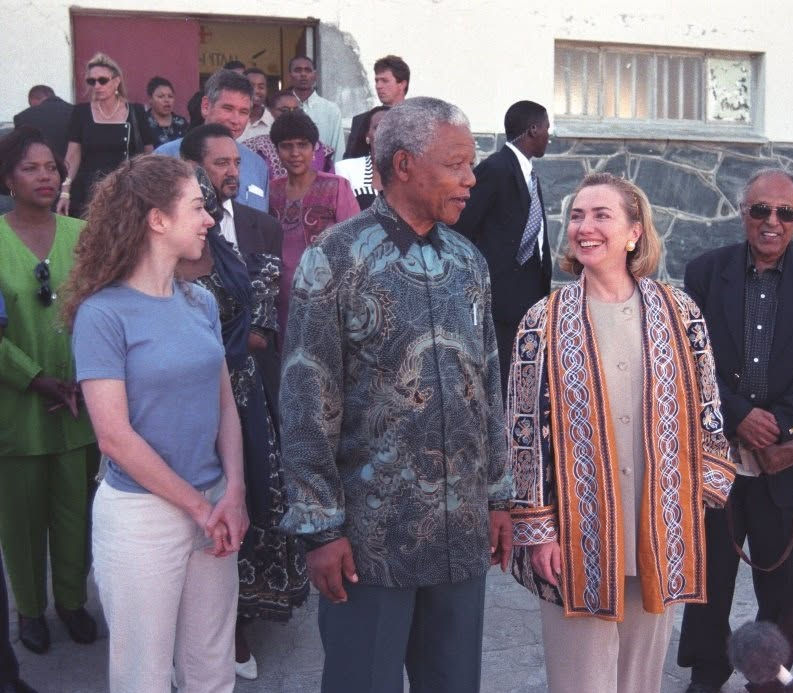
I was struck by a story about Hilary Clinton’s visit to Robben Island. They decided that a First Lady shouldn’t ride around in their old busses, so they decided to fly a new bus out to the island with a helicopter.
But the cord broke and the bus crashed into the ocean. What a waste of money! If I ever become First Lady, I will not accept such a thing.
September 17, 2004 – Cape Town
Back in Cape Town, I had fish and chips, bought some stamps, and had a coffee by the waterfront. I wandered around a bit, looking for a souvenir.
I ran into Sybille and Yvonne — two Swiss girls that I’ve met at Big Blue Backpackers. They were having milkshakes, and we had an interesting conversation about how America influences the rest of the world.
Unfortunately, it does so by sharing absolutely the lowest, least-intelligent, forms of culture — McDonald’s and reality TV shows. I shared with them some of my experiences in Gabon.
Yvonne is a very open, sensitive girl. I really like her. She said this was the most interesting conversation she has had on her travels… that most people are just superficial.
After complaining about this myself just a few days ago, I have to say that I’ve met some very interesting people in South Africa — very thoughtful and intelligent people.

Actually, it seems on this trip that there is something profound I am meant to learn from each person I encounter. It’s almost spooky how appropriate and timely some of these encounters are.
I feel very alive and on fire — ready to learn as much as I can.
September 17, 2004 – Cape Town
This morning I went to the Two Oceans Aquarium. I had not given any thought to the incredible variety of life forms under the water, and I was completely blown away by their beauty and complexity.
What is their purpose, these highly evolved, colorful fish, crustaceans, eels, weird seahorses, lobsters, sea snakes? Why so much variety? And these microscopic planktons that seem to exist for the sole purpose of feeding everything else, including whales.
I was amazed by the jellyfish. You can see right through them, and yet they are alive! HOW?

My favorite exhibit was an old man — he must be 85 or 90 — named Les.
Les was very excited about the microscopic starfish and anemones and was very eager to tell everyone about them.
He had several bowls of tiny animals and he would move the microscope so you could see things on the TV set.
I was touched by this man and his clear passion for what he was doing. His nose was dripping like an old man’s does — I could have watched him for hours. I wanted to get to know him. He was SO old.
If he didn’t love what he was doing, he would certainly be at home, retired, resting. I was very impressed by his energy, and touched by the beauty of the old teaching the young.
In a few hours I go to the airport to begin my 32-hour trip home to the States. I haven’t given a single thought to being home and I’m not sure how I’ll feel about it.
But these wonderful girls I’ve met at the hostel are being very supportive. They have changed their plans for this evening around sending me off to the airport. I feel loved.


Comments